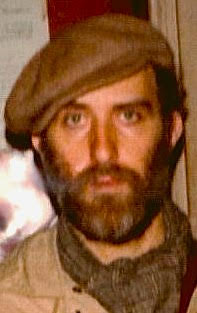
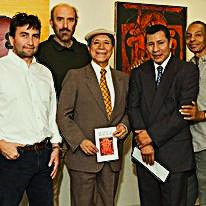
Rodeiro in front of the Bateaux Lavoix, Montmartre, Paris
Discover the Visionary World of José Rodeiro
Explore the transformative impact of Neo-Latino art through the eyes of a pioneering artist.
José Rodeiro: A Journey Through Art
José Rodeiro’s artistic journey is a testament to his profound influence on contemporary Latino art. From his early involvement in Immanentism to his pivotal role in Neo-Latinoism, Rodeiro has consistently pushed the boundaries of artistic expression. His work not only reflects a deep understanding of cultural dynamics but also serves as a catalyst for social change, as seen in his participation in significant art movements and exhibitions worldwide. As an honorary member of prestigious art societies, Rodeiro continues to inspire and shape the future of Latino art.
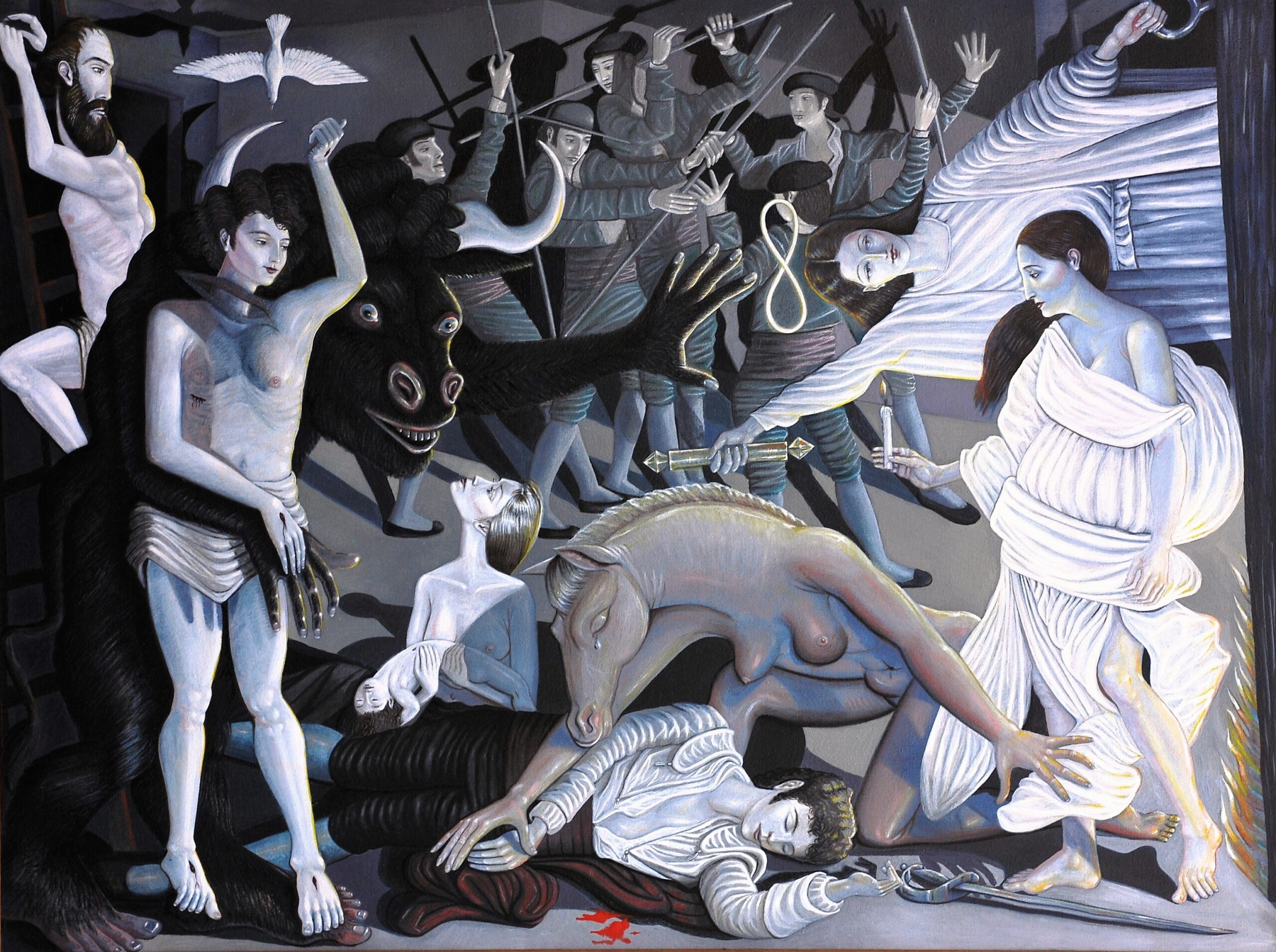
Rodeiro was born in Ybor City, Tampa, Florida to Dr. José Antonio Rodeiro and Olga Pérez Rodeiro. He is the brother of two sisters Joyce and Irene. In 1960, at age 11, he began studying painting with Samuello Brocato, a Florida painter trained in New York City’s Art Students League and Pratt Institute. From 1963 to 1967, Rodeiro attended Tampa’s Jesuit High School where he studied visual art with Fr. James Mcleod (SJ) and where he developed a life-long passion for knowledge and creating art. As a result, upon graduating from Jesuit, he pursued both academic and artistic aspirations, eventually earning a Ph.D. from the College of Fine Arts, Ohio University, Athens, Ohio, 1976. And, an MFA in Painting from Pratt Institute, NYC, 1973, and a BA in Art from the University of Tampa, 1971. While in Ohio, in the late-1970s, he met and married Annette (“Nutia”) and fathered two children Manuel (a philosopher) and Tatiana (a dancer).
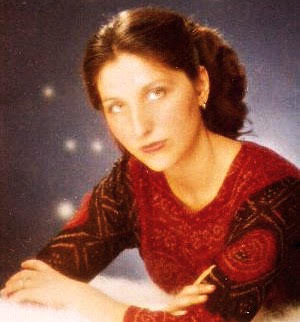
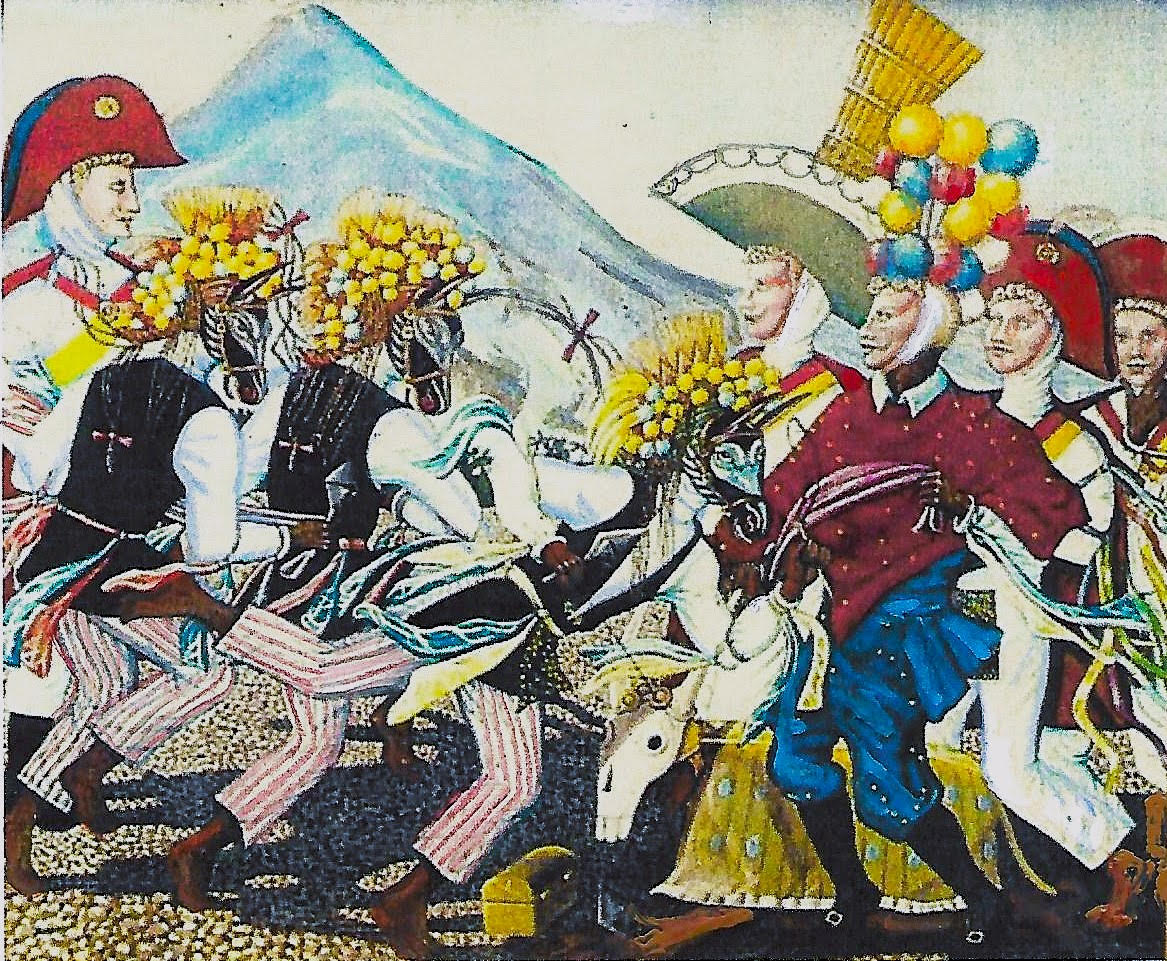
His university-level artistic mentors include: Lewis Harris, Joe Testa-Secca, Dr. Duane Locke, Dr. Philip Rodman, Dr. George McNeil, Dr. Nan Benedict, Dr. Ralph Wickiser, Walter Rogalski, Irwin Hollander, Professor Sidney Alexander, and Dr. Barry Katz. By the 1980s, Rodeiro’s art began attracting major fellowships and grants, including an Institute for International Education grant (Oscar B. Cintas Fellowship in painting (1982); a Visual Artist Fellowship in painting from the National Endowment for the Arts (1985), which he completed between 1986-1987 in Barcelona, Spain, while on an extended sabbatical from the University of Maryland’s Frostburg campus. He then obtained a grant from the BID (the Inter-American Development Bank, Washington, DC) to exhibit and promote Nicaraguan Art within the USA’s Mid-Atlantic region. Then in 1993, he received a Fulbright Fellowship Scholarship grant to paint a maquette on canvas for a mosaic mural at UCA (the University of Central America), Managua, Nicaragua, coinciding with a sabbatical from New Jersey City University, Jersey City, NJ. The UCA’s rector Fr. Xabier Gorostiaga desired a large mosaic mural depicting Nicaraguan Güegüense dancing. Sadly, with the departure of Gorostiaga from UCA in late-1990s and his death in 2003, the Güegüense mural project ended.
Throughout his creative life, Rodeiro always sought enduring artistic fellowship with other artists, starting in the 1960s in Florida with Duane Locke’s Immanentists movement, which included the following poets and visual artists: Alan Britt, Steve Barfield, Nicomedes Suarez, Silvia Scheibli, Paul Roth, Charles Hayes, Stephen Sleboda, Connie May Fowler, and others. By 1973, in New York City, Harry Smith, editor of The Smith Press (by arrangement with Horizon Press), published “The Immanentist Anthology,” which included poems from several of the above Immanentist poets as well as drawings by Lewis Harris, José Rodeiro, Nicomedes Suárez, Salvatore Tagliarino. Plus, the book contained Locke’s groundbreaking “Immanentist Manifesto” (“Our Poetry: Toward Linguistic Reality, an Art of the Superconscious”). Then, in 1973, Bolivian poet and art theorist, Nicomedes Suárez fostered an aesthetic concept that he named Amnesis, advocating that artistic creativity owes less to Mnemosyne (goddess of memory) and her daughters, the nine muses and more to Lethe, the goddess of forgetting. Suárez argued that what is unremembered (or the lacunae of irretrievable amnesia) is the ultimate source(s) of all ‘true’ artistic inspiration and all creativity. For him, art is the retrieval of lost objects. Lost objects are indelible emblematic representations of absence, refashioning every semblance of the concrete. And, this relentless feeling of loss, reorientation, and emptiness (mental voids) prompts what Suárez calls “fabulation(s),” which are envisioned by fabulists (aka artists) into “fabunirs,” that recreate departed memories into lost objects. After first meeting Suárez in Tampa, Florida in 1968, Rodeiro collaborated with him on many art-related endeavors throughout the United States, South America, and Europe.
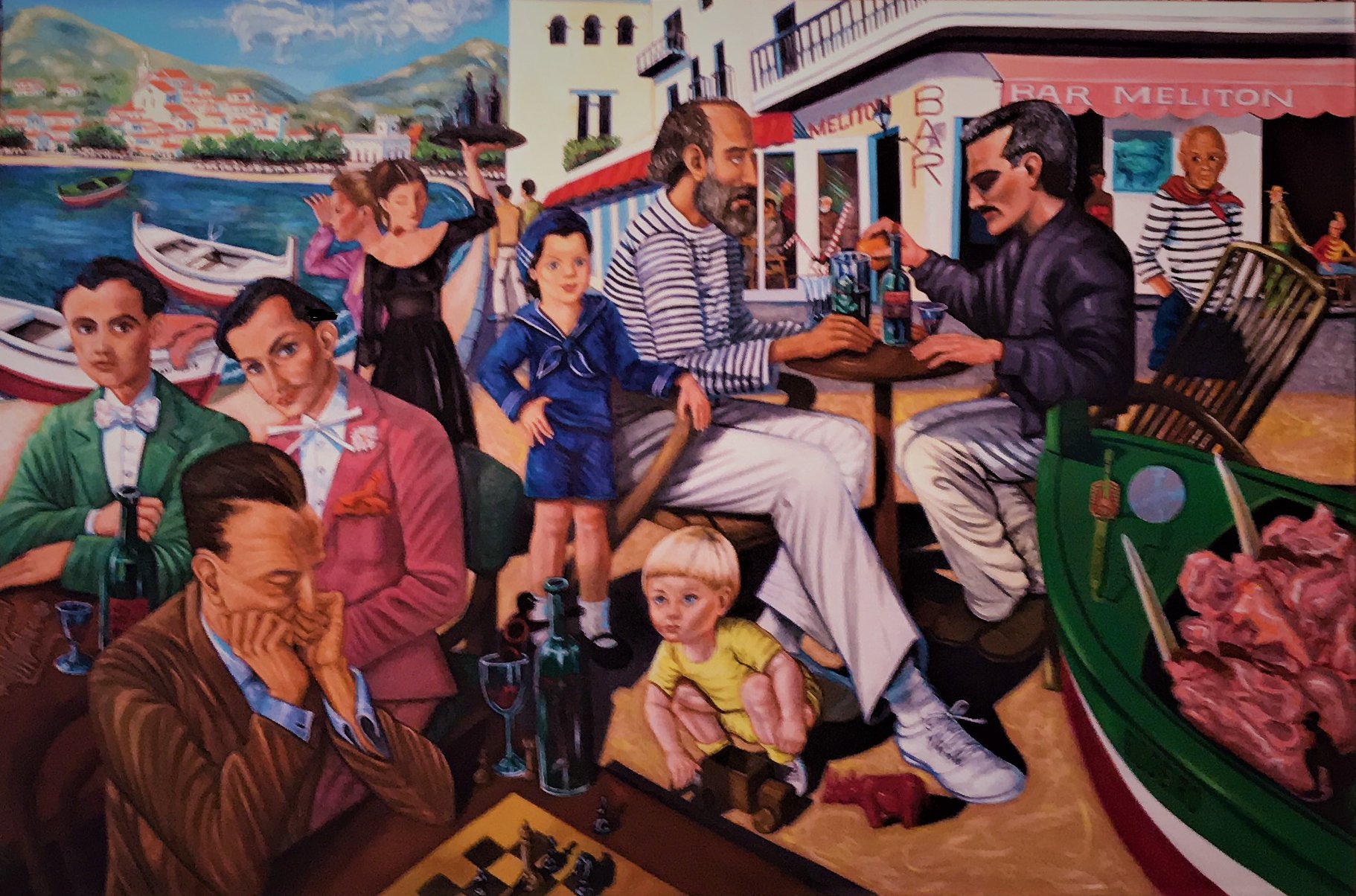
Jose Rodeiro with acclaimed poet Dr. Duane Locke.
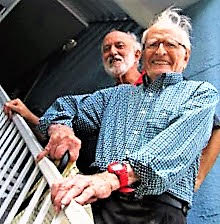
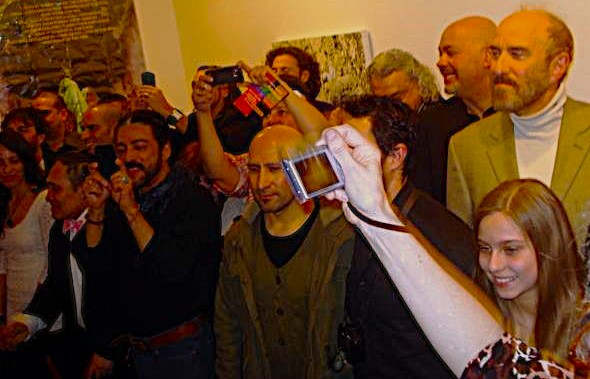
The “We Are You Project International” artists at WAYPI’s inaugural exhibition at Kenkelaba Gallery’s Wilmer Jennings Gallery (The New York State Arts Council Gallery in Manhattan, NYC, NY). In the last row standing in front of Hugo Bastidas’s 2009 tonal painting “Bearing Gifts” are artists: Duda Penteado, Fernando Goldoni, Jesus Rivera, Raúl Villarreal, and José Rodeiro. In the middle row are José Acosta, Gerardo Castro, Rosario D’Rivera, In the front row are Hugo X. Bastidas, Elizabeth J. Montelongo, Carlos Chávez, Willie Báez, Pablo Caviedes, Sergio Villamizar (with the hand of Lucy Santiago holding a camera-phone inadvertently hiding his face), and lastly singer-songwriter Sophia Angelica.
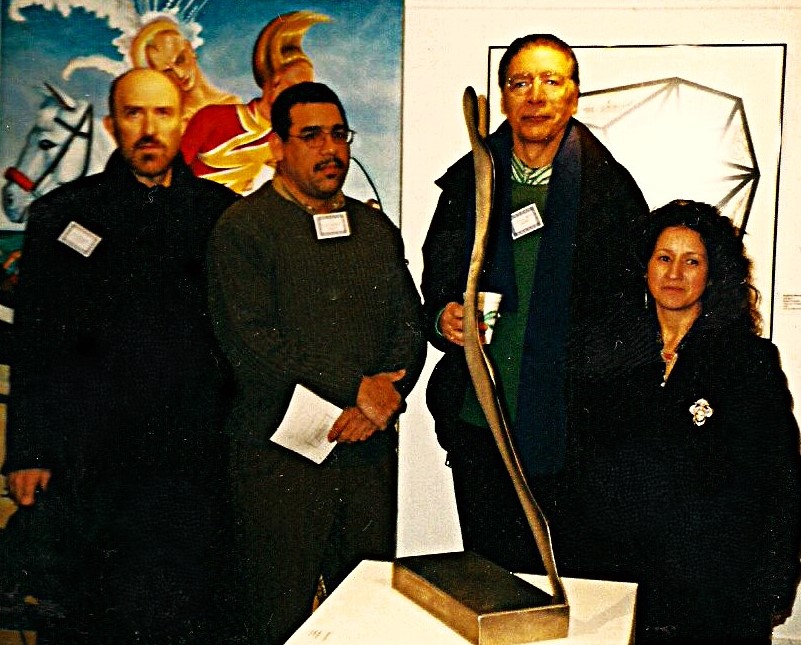
A photograph of Hugo X. Bastidas, José Rodeiro, Jaime Andrade, Hugo W. Morales, and Ben Jones, during a 1999 exhibition at NJCU of Andrade’s paintings.
At the start of the 21st Century, Rodeiro’s search for lasting artistic fellowship with artists continued. For example, from 2003 to the present, Rodeiro joined several artistic cohorts, starting with the NYC metropolitan-area group known as “The Neo-Latino Art Movement,” named in 2003 by Cuban artist, Raúl Villarreal, At that time, the Neo-Latinos included Josephine Barreiro, Hugo Bastidas, Gerardo Castro, Williams Coronado, Olga Cruz, Hugo Morales, Lisette Morel, Dr. Isabel Nazario, Julio Nazario, Monica S. Camin, Sergio Villamizar, Ricardo Fonseca, Christie Devereaux, Nelson Alvarez, and Olga M. Bautista. Interestingly, today, the Neo-Latinos are recognized art historically as the first major art movement of the 21st Century, and they are still very active as “The Neo-Latino Collective.” Via his friend Dr. Midori Yoshimoto (the director of NJCU’s Galleries), Rodeiro met Robert Rosado, the Founder in 2004 of La Ruche Art Contemporary Consortium (LRACC), Union City, NJ, with its coterie of major metropolitan-area artists, i.e., José Acosta, Nelson Álvarez, Willie Baez, Pablo Caviedes, Carlos Chávez, Rosario D’ Rivera, Walter Barco, etc. Along with these artists, Rosado also introduced Rodeiro to his friend Lucy Santiago, the CEO of the Fundacion Manos a la Ayuda, Inc., New Jersey.
With the help of Gabriel Navar, Raúl Villarreal flew with Rodeiro to Oakland, CA, where they met Joyce Gordon, Eric Murphy, Rochelle Leininger, and explored the Bay Area’s vibrant art scene, viewing art by exciting artists like Mel Ramos, Gabriel Navar, Patricio Moreno Toro, Efren Ave (a.k.a. Efren Álvarez) and Elizabeth J. Montelongo. Meanwhile back in New York City and New Jersey, Rutger’s Center for Latino Art & Culture and its 21st Century Transcultural New Jersey Initiative guided Raúl Villareal, José Rodeiro, and Robert Rosado to meet Raphael Montañez Ortíz, Roberto Márquez, Dr. Isabel Nazario, Julio Nazario, and Marta Sánchez.
In addition, Hugo W. Morales (Director of NJCU’s Council of Hispanic Affairs (CHA)) encouraged Rodeiro and Villarreal to make contact with Jacqui Casale (aka, Jacqui Taylor Basker), Maritza Dávila, Priscila De Carvalho, Fernando Goldoni, Ana Rivera, Jesus Rivera, and, Duda Penteado. The Brazilian artist, Duda Penteado had a brilliant idea to join all the above-mentioned groups together as part of a project titled “We Are You (WAY)” that he was developing together with Dr. Carlos Hernández (President of New Jersey City University) and Mario Tapia (President & CEO, Latino Center on Aging). Thus, in fall 2011, under the moniker “The We Are You Project International (WAYPI);” all of the above-named Latino visual artists exhibited their art in WAYPI’s inaugural exhibition at Kenkelaba Gallery’s Wilmer Jennings Gallery (The New York State Arts Council Gallery in Manhattan NYC, NY), as well as garnering (with the help of Alan Britt) an array of major internationally celebrated WAYPI poets for the We Are You’s poetry initiative, including: Alan Britt, Colette Inez, Michael Foldes, Steve Barfield, Alberto Blanco, Carmen D. Lucca, Gabriel Navar, Bina Sarkar Ellias, Silvia Schiebli, Gloria Mindock, Lilvia Soto, Alex Lima, Pablo Caviedes, Flavia Cosma, David Ray, George Nelson Preston, Dio-Genes Abreu, Carmen Valle, Grace Cavalieri, Katherine Sanchez Espano, and Penteado.
Then, in 2010, in partnership with Sergio Villamizar, Rodeiro developed a Duende-themed two-person art exhibit supported by Passaic County’s Cultural & Heritage Council at Passaic County Community College (NJ) curated by Jane Haw PCCC’s gallery director, examining Federico Garcia Lorca’s “Theory of Duende” in relationship to visual art, resulting in a “Duende Art” wix-site URL: https://svillamizar.wixsite.com/duende , featuring duende art works by Olga M. Bautista, Monica S. Camin, Christie Devereaux, Charles Hayes, Hugo W. Morales, Lisette Morel, Duda Penteado, Bruce Rice, Raul Villarreal, along with Villamizar and Rodeiro. In 2019, the site generated a Duende Art exhibition curated by Hugo Morales and Bruce Rice at the William V. Musto Cultural Center (Union City Museum), Union City, New Jersey.”
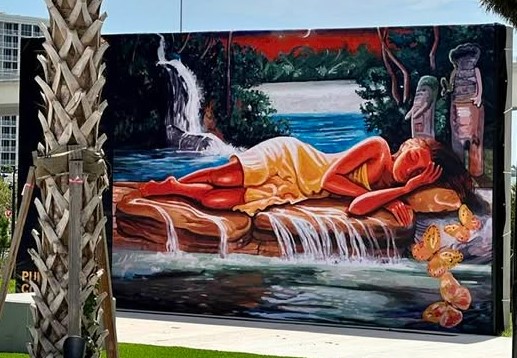
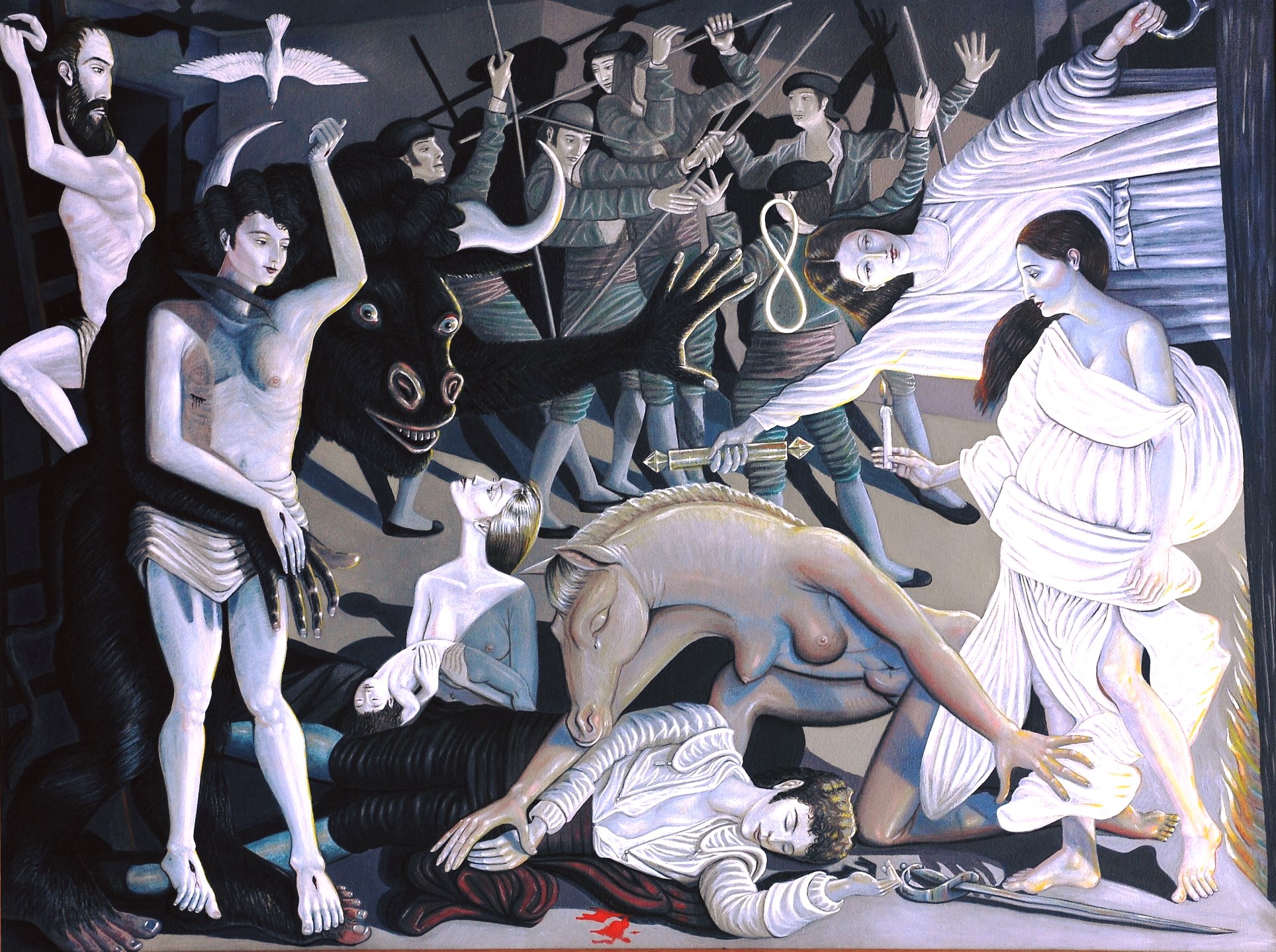
Throughout these years, Rodeiro exhibited his art extensively within the USA, e.g., Miami-Dade Museum of Art & Design, Miami, Florida; The Monmouth Museum, Lincroft, New Jersey; Union City Museum, Union City, NJ; The Museum of Fine Arts, Washington County, Hagerstown, Maryland; Mason Gross Gallery, Rutgers University, NJ; Wilmer Jennings Gallery, Kenkelaba Gallery (the New York State Arts Council Gallery in Manhattan) NYC, NY; Florida International University’s Frost Museum (Miami, FL), The Korea Gallery (NYC, NY), Newark Museum, Newark, NJ; NJPAC, Newark, NJ; Galleries of Contemporary Art (GoCA), University of Colorado, Colorado Springs, CO; Rutgers University’s UMDNJ’s Robert Wood Johnson Gallery, New Jersey; Joyce Gordon Gallery, Oakland, California; Perth Amboy Gallery (Center for the Arts), New Jersey; El Museo de la Historia de Ponce (“MoHP”), Ponce, Puerto Rico (curated by Rosado); as well as several La Ruche Art Consortium exhibitions in Union City and Rahway, NJ; PCCC Broadway/LRC Gallery (Paterson, NJ); plus, Dr. Virginia Butera’s curated shows at 14 Maple Gallery (Morris County Arts Council/Geraldine Dodge Foundation), Morristown, NJ; and the Therese A. Maloney Art Gallery (College of Saint Elizabeth, Morristown, NJ); in 2023, Tarin Mohajeri curated “El Arte: Echoes of Cuba” for Clearwater’s Community Redevelopment Agency, Clearwater, FL; Gallery Aferro’s “FLOW” show, Newark, NJ (curated by Lisette Morel), and other venues. In the Tampa Bay area, he has exhibited with Dr. Natalie Velez’s Bella Unica Art Gallery where he met many outstanding artists, i.e., Dee Perconti, Linda Roberts, Debbie Bright, Gina White, Marian Tagliarino, Eddie Vélez, Ronn Johnson, Robert Sutherland, as well as exhibiting at Carrollwood Cultural Center, thanks to two CCC curators, Michele Stone and Willow Wright. along with showing at Morean Art Center. In the 21st Century (from coast-to-coast), Rodeiro’s art has graced myriad poetry book covers as well as other book covers, every cover can be seen via FACEBOOK’s José Rodeiro FB site. In October 2009, Rodeiro lectured on his painting “9/11” at The Tribute WTC Visitor Center (at Ground Zero, New York City, NY).
Exploring Artistic Movements
The Five Art Movements of José Rodeiro
José Rodeiro is a pivotal figure in several influential art movements. Immanentism, initiated in the early 1970s, focuses on ‘Thing-Thing Metaphysics,’ bringing together poets and visual artists to explore metaphysical themes. Amnesis Art, or Amnesia Art, founded by Dr. Nicomedez Suárez-Araúz, delves into the concept of cultural and historical memory, attracting a diverse group of international artists. Neo-Latino Art, a transcultural movement, has been a dominant force in the New York/New Jersey Latino art scene, emphasizing cultural identity and artistic expression. La Ruche Art Consortium, known for its inclusivity, showcases a wide array of Latino and non-Latino artists, fostering a rich cultural exchange. Lastly, Pura Cuba, led by Raul Villarreal, celebrates Cuban heritage through vibrant and evocative artworks, showcasing the talents of Cubaphile artists worldwide.